My UPD8
Login to download activities, post reviews and discuss breaking science. To sign up click on join UPD8 below.
Christmas trifle


Type: Activity
Learning Strategy: Simulation
Topic: Particles
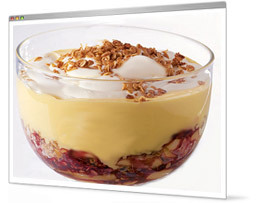
Christmas – a time for giving, sharing, caring…and eating. Many families will tuck into trifle this Christmas. The nice thing about trifle is the mixture of textures. How do cooks, chefs and food scientists get these textures from a limited range of starting materials?
In this Christmas-themed activity students learn about colloidal mixtures and the importance of a balanced diet. They also consider the skills needed to become a food scientist – and are perhaps inspired to think more about the possibility of this as a future career.
11-16 How Science Works:
Data, evidence, theories and explanations
1c Explanations of many phenomena can be developed using scientific
theories, models and ideas.
Published: 12th December 2007
Reviews & Comments: 3

Learning objectives
• Consider the skills needed to be a food scientist.
• Consider the nature of various colloidal mixtures.
• Consider the need for a balanced diet.
Try the activity
- trifle teachers notes
Downloaded: 553 times - trifle activity
Downloaded: 1013 times
You will need Acrobat Reader installed to open the activity sheets.
Curriculum link
11-14 (KS3)From September 2008
1.1a Using scientific ideas and models to explain phenomena.
3.2a The particle model provides explanations for the different physical properties and behaviour of matter.
3.3c Growth, development, behaviour and health can be affected by diet.
Until September 2008
QCA unit 7g Particles
QCA unit 8a Food and digestion
14-16 (KS4)
How science works
Data, evidence, theories and explanations
1c Explanations of many phenomena can be developed using scientific
theories, models and ideas.
GCSE specifications
AQA – Core
Unit C 1b
11.2 What can we do to keep our bodies healthy?
AQA – Applied
Describe the composition of a solution, suspension, gel, emulsion, foam and aerosol
Edexcel
Unit C 1a
6.14 Recognise cooking processes as chemical changes leading to new products
Unit B3
1.7 The importance of having a well-balanced diet, in terms of a healthy lifestyle
OCR 21st Century Science
Module C3
C3.4 Why does what we eat affect our health?
Running the activity
Page 1 This introduces the idea of the job of food scientist and suggests to students that a knowledge of the chemistry behind making food taste good is an important requirement for the job, and prompts them to find out further skills / knowledge / qualifications / personal presentation and attributes they would need (see page 3 for more information page 4 for the task).
Page 2 A chef explains the science behind the different layers. There are no diagrams on the page as the next task is to draw particle diagrams from the written information. It may be useful for teachers to draw diagrams on the boards as the page is discussed, then remove them before the next page's task. Note that traditionally custard is made with milk, sugar, vanilla and eggs however most custard in Britain is the type invented by Bird's, which uses cornstarch instead. Foams, gels and emulsions are all colloids – there is a link to information about colloids below.
Page 3 is a job description for the role of food scientist.
Page 4 Students use the information from page 2 to draw particle diagrams to show the arrangement of particles in each mixture and the information from page 3 to complete the third part of the task.
Page 5 Christmas foods usually contain lots of fat and carbohydrates to give us energy and keep us warm over the winter. But excess energy gets stored as fat – and too much body fat can damage our health. Students use the Eatwell plate on page 5 to design a 3 course menu (the number of choices for each course can vary according to the amount of time available, and it can be Christmas-y or not) and then write Santa a letter to tell him how to eat well in future.
Web links
News links
- Cooking911
- How to get the air into whipped cream.
Media links
- Wikepedia
- Foams, gels and emulsions are all colloids – a useful at a glance guide.
- Wikepedia
- How to get the bubbles of air into a sponge cake.
- Howstuffworks
- Explains why jelly is so wobbly.
- Wikipedia
- Explains why cooked custard is different from an uncooked mixture of custard powder with water - the stuff you can walk on.
- Food Standards Agency
- Downloadable pdf of the eatwell plate.
Reviews & Comments
Write your online review to share your feedback and classroom tips with other teachers. How well does it work, how engaging is it, how did you use it, and how could it be improved?
science
Jun 27th, 2008

I have not downloaded any activities as such or used. So I cannot give you my views at the moment, but I use them I wii surely let you know.
Reviewer: hansika pandya
Christmas trifle review
Jan 2nd, 2008

I have used other activities on this website for my classes and found them brilliant, but not this one. I had hoped to use it in the last lesson before christmas with a very bright year 8 group. unfortunately I think some of the concepts in the particle diagrams section are too difficult. Anyone care to share the answers?
Reviewer: Emma Caine
21st century science
Dec 14th, 2007
i am HLTA
just found this site by chance
looks very good
i will comment in detail later but this could be very useful for my college. keep it coming
please try and create more activities for ks4 21st century science.
5 star rating
Reviewer: krishna kaur

Related Activities
Chemistry / States of matter
Hot Topics / Diet
How Science Works / Theories & models
- Global Warming Swindle
- Firstborns get the brains?
- Pomegranate ovary model
- Conjoined
- CSI 5/11 - Murder in the Park re-published
- Homeopathy: is it Science?
- CSI 5/11 - Murder in the Park
- Climate control
- So windy
AQA / C1b Oils, Earth & atmosphere
- Global Warming Swindle
- Biodiesel
- Is it terminal for Teflon?
- Climate control
- Journey to the Centre of the Earth
- Global warming-do 'the facts' stand up?
- Friendly Floaters
Edexcel / C1a Patterns in properties
21st Century / C3 Food matters
21st Century / Developing explanations
QCA / 7G Particle model of solids, liquids & gases
- New, revised! What's cooking
- New, revised! 'Fake'
- Cyclone
- Scratch proof
- What's moving on Titan
- Making Rain
QCA / 8A Food & digestion
- Bushtucker challenge
- Obesity and cancer
- Should we be worried about salt?
- Inside Easter Eggs
- Brain power booster
- Healthy Eating
- Camel Milk
Ideas about Science / Interpreting evidence
- New, revised! Mammoths extinct
- Pomegranate ovary model
- Boys, girls, and chimps
- The short side of the family
- Secrets from the ice
- Pluto: a planet no more
- Fast car
- Gold
- Shampoo claims - truth or lies?
- Goya: huge, hunted, and extinct
- Shrinking Everest?
- Rats
- Acid rain: Britain recovers?
- MMR