My UPD8
You need to login before you download the free activities. You can register here.
- The Centre for Science Education
- The Association for Science Education
- Partners
- Part of ASE online
Mammoths extinct - Extinction activity from Wikid


Type: Activity
Learning Strategy: Imaginative inquiry
Topic: Feeding relationships
This activity is a sample from the upd8 Wikid Y7 proghramme. Find out more about the course
Introduction to the Extinction unit
As the Arctic ice melts away, polar bears are sliding towards extinction. Climate change is radically altering many of the Earth's environments. Will other species be able to adapt? Earth's history also shows there have been many extinctions in the past. So should we be worried that species are dying out today? And which should we be trying to save? Students are trainee reporters for environmental awareness channel Planet TV. As part of their assignments they learn about the changing atmosphere, adaptation, variation and classification, behaviour, collaboration, developing argument and scientific communication.
About this activity
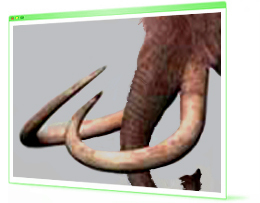
The students are on their first assignment as trainee reporters for Planet TV. They have been sent to Siberia where they helped Lauren, an experienced reporter, produce an 'on the spot' news report on the discovery of a frozen baby mammoth. They learned what Europe was like 15,000 years ago when mammoths were alive and suggested what might have changed to make Mammoths become extinct.
Now their editor thinks there's a bigger story so they are sent to Yakutsk to cover a Mammoth conference. They collect evidence from an international panel of experts to find out what changed when the mammoths became extinct. The experience shows scientists from different disciplines collaborating to gather evidence and come up with explanations.
11-14 How Science Works:
The unit focusses on 'Scientific Communication': (PoS 2.3, strategy 1.1a2)
Good communication captures attention, keeps the audience interested, and gets the message across with clarity and impact.
Published: 3rd June 2008
Reviews & Comments: 7
Learning objectives
- The composition of the atmosphere has changed continuously since Earth formed and so has the climate.
Try the activity
- Mammoths detailed lesson plan
Downloaded: 2913 times
You will need Acrobat Reader installed to open the activity sheets.
Curriculum link
Changing atmosphere (PoS 3.4c, strategy 5.3)Running the activity
Download the lesson plan for full details.
Web links
News links
- upd8 wikid course
- Details of the science course for 11-14 year olds from which this sample came
- upd8 Segue course
- Details of the Y9-GCSE transition course that follows on from Wikid.
- Wikid assessment criteria: Missions
- To assess students' grasp of particles from this activity, or other objectives in the Wikid course. It is a booklet of assessment criteria at every level of understanding.
Reviews & Comments
Write your online review to share your feedback and classroom tips with other teachers. How well does it work, how engaging is it, how did you use it, and how could it be improved?
Mammoths
Oct 24th, 2012

Thank You for this website. It is extremely useful and there are lots of activities. If possible does anyone have the Mammoths Assessment sheet where it lists all the grades and what you need to include to achieve it. Please as soon as possible help me, I'll be really grateful. Thanks once again.
Reviewer: Hirishika Rajasekaran
Pyrotechnics
Jun 2nd, 2012
Where is the pyrotechnics end of unit assessment paper???
Reviewer: qwer wery
website and student sheets
May 12th, 2012

I am encountering problems accessing the 'explore' website and students sheets
Reviewer: anita chaudhary
Mammoths`S activity
Apr 26th, 2010
I`m very glad that there is a web site like this. It is very useful for teachers to find resources for their lessons. in my case, I work in a very poor institution; here in Costa Rica, the entity managing public education is not able to provide all the tools required by teachers in order to work properly. Then, this year the high school where I work received 10 laptops in order to encourage teachers to use technology to teacher their lessons. As a result, all of us are tryng to find material to use it in the laptops and i just discovered this wonderful web. i will make use of the activity worksheet in two days so after seeing the reaction of my pupils i`ll comment more....thank u.
Reviewer: ELKINM FRAZER
Science
Aug 27th, 2009
I have used the resources and they are great for the pupils as they are engaging and creative activities for pupils to develop themselves.
Mohammed Khan
Handsworth Grange Community Sports College
Reviewer: Mohammed Khan
year 7 science
Jul 10th, 2009
The resources were excellent but required a lot of organising before the lesson. It required two lessons to really do the topic justice. Overall I was very impressed.
Reviewer: caroline morrison
Mammoths extinct - Extinction activity from Wikid review
Dec 9th, 2008
Good resource to use as part of the evolution topic in year 10
Reviewer: Sarah Brookes

200 lessons and assessments from as little as £4.95
Related Activities
Ideas about Science / Data collection & analysis
- Time raiders - death of a mummy
- Choosing trainers
- Bushtucker challenge
- Inside Easter Eggs
- When will women overtake men?
- False diamonds
- Healthy Eating
- Riches from the Wind
- High Speed Risk
- Should we be worried about salt?
- Turkey
- Santa 2025
- Think 30 for a reason
- Winter Olympics
Ideas about Science / Interpreting evidence
- Death of an angel
- Christmas trifle
- Pomegranate ovary model
- Boys, girls, and chimps
- The short side of the family
- Fast car
- Secrets from the ice
- Pluto: a planet no more
- Shampoo claims - truth or lies?
- Gold
- Shrinking Everest?
- Goya: huge, hunted, and extinct
- Rats
- Grow your own body
- Ban cola?
- Attack of the giant viruses
- Solar roadways
- Life on Enceladus?
QCA / 7C Environment & feeding relationships
Hot Topics / Disaster
- PiggiFlu is coming
- The Day After Tomorrow: The Prequel
- The Day After Tomorrow
- Tsunami Warning
- So windy
- Arctic seed bank
- Attack of the giant viruses
Biology / Feeding relationships
- Vultures: the next dodos?
- Monster crab invasion
- Mite Attack
- Goya: huge, hunted, and extinct
- Rats
- Chernobyl 20 years on
- Invasion!
Earth Science / Atmosphere & climate change
- Green Biker
- Food for Thought
- Secrets from the ice
- The Day After Tomorrow: The Prequel
- The Day After Tomorrow
- Sinking island
- Eat insects