My UPD8
You need to login before you download the free activities. You can register here.
- The Centre for Science Education
- The Association for Science Education
- Partners
- Part of ASE online
Deadly Dengue


Type: Activity
Learning Strategy: Case study
Topic: Infectious disease
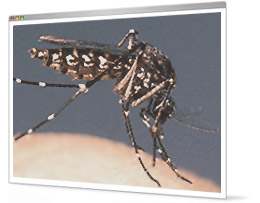
In tropical parts of the world, mosquitoes can give you more than just an itchy bite! They spread dengue fever - a serious viral illness. Millions catch it every year, and thousands die. It's a major hazard and there is no vaccine for it. But many Vietnamese villages are disease free. It's thanks to the efforts of local children. They are working alongside scientists in a very successful program of biological control. The exciting thing is that they are cutting mosquito numbers without contaminating their environment with harmful insecticides. This poster-making activity reinforces students understanding of food chains as they work out how the children eliminate the virus and explain why the strategy works.
Published: 23rd February 2005
Reviews & Comments: 10
Learning objectives
Students will learn how the spread of a major viral disease can be limited by biological and environmental control and reinforce their understanding of food chains.
Try the activity
Please login to download activities
Curriculum link
Microbes and disease [QCA 8c] – viruses are microorganisms and can cause diseases; antibiotics are not effective against viruses; scientific advances may depend on creative thought.Environment and feeding relationships [QCA 7c] – describe food chains within an environment; relate habitats to the organisms found in them.
Running the activity
Suggested time: 20 minutes – a whole lesson, depending on how much time students are given to prepare their posters.
Possible starter:
To set the scene, show students page 1. Elicit some suggestions as to how the virus could be controlled before letting them see page 2.
Main activity:
Students use the information on page 2 to complete a poster. There is a template for the poster on page 3. This has lots of gaps for drawing diagrams and pictures, so they can make it very visual. It's worth stressing that they need to make sure that poor readers can understand the message too. You may want to photocopy this page onto A3 so that pupils have more space for their diagrams.
Possible plenary:
Each student looks at another's poster. They say one thing they like about it and suggest one improvement. Students could also be encouraged to say why this form of control is preferable to chemical controls, and to suggest why the project has been so successful in the Vietnamese villages.
Background Notes:
Spraying the mosquitoes that carry dengue fever with insecticide is expensive and ineffective. The insecticide particles have to come in contact with the mosquito to kill it. Unfortunately, the Aedes aegypti mosquito tends to spend a lot of time inside houses. They hide away in cupboards that are not easily penetrated by the sprays. The low-tech strategy the children are involved in has eradicated the disease in most of the villages where it has been implemented. They pour tiny crustaceans called Mesocyclops into the large water tanks and wells used in poor areas, where piped water supplies are unreliable. This is where the mosquitoes prefer to lay their eggs. The crustaceans ensure that few mosquito larvae survive to adulthood. The children also put lids on the tanks to keep mosquitoes out and clear away any rubbish, like old buckets and cartons, that could collect rainwater. Whilst the project has been very successful in the villages, different strategies will be needed in towns where the mosquitoes breed mainly in places like roof gutters.
Web links
News links
- BBC
- A good introduction to the story.
- New Scientist
- More information on both dengue and the eradication project in Vietnam.
- Division of Vector-Borne Infectious Diseases.
- Detailed background information about the transmission and distribution of the disease. Good slide shows, with useful pictures, and a PDF Dengue Fact Sheet.
- GM mosquitoes
- Videos about how GM mosquitoes can be used to control the spread of the disease.
Media links
- Dengue virus replication
- This visualization represents the process by which a dengue virus releases its genetic contents inside a host cell, allowing viral replication.
Reviews & Comments
Write your online review to share your feedback and classroom tips with other teachers. How well does it work, how engaging is it, how did you use it, and how could it be improved?
Dengue
Oct 13th, 2011

I live in a part of the world where dengue is speading quickly. We have incorporated lessons on how to recognize, prevent and take care of a dengue patient in our regular science lessons. That is why I downloaded the activity. I used it in my classroom and found it to be very benficial.
Reviewer: Purvin Arshad
science
Mar 23rd, 2011
Looks fantastic needed something interesting to teach biological control and this is perfect- big thank you
Reviewer: lyn Ottaway
Science
Jan 28th, 2010
REally really useful my pupils enjoyed this activity nas a plenary for the microbes topic.
Reviewer: Liberty Kathro
Deadly Dengue review
Jun 2nd, 2009
Reviewer: Laura Johnson
biology
Jun 23rd, 2008
recently we are adapting our year 7 curriculum and I have found this activity very helpful
Reviewer: jamila sarwar
Deadly Dengue
Oct 26th, 2007
Very useful, with abit of tweaking this has fitted very well into WJEC GCSE biology.
Reviewer: Ian Spilsbury
Deadly dengue
Jun 7th, 2007
Great resource, used with mixed ability Year 8 class and they enjoyed using the information to present and create posters to back up their presentations. Pictures and video clips are very good, the students enjoyed the gore factor of the clip.
Reviewer: Paul Myatt
Dengue Fever
Oct 17th, 2006

Good - used as a plenary with a high abilty Y10 in combination with the linked New Sceintist article. A nice example of biological control.
Wiith mid set Y8 - told the story as a plenary and they really enjoyed the video clip!
Reviewer: Paul Morrison
Deadly Dengue
Jul 23rd, 2006
I used this activity with 2 groups - a top ability year 8 (current levels 6) and a lower ability group (current level 4). Both groups found the task engaging despite the 90 degree temperature. The video clip was stimulating. Amplification was needed on the ecomic and social consequences that this disease would have on a community. The lower ability group required more teacher input at the start of the task to set it up;
Reviewer: Jakki Ellis
video on Denge fever solution
Mar 1st, 2005
This is brilliant to be able to see how the microorganism actually eats the mosquito larvae. I can use this with the interactive whiteboard to introduce the activity. A picutre is worth a hundred words, and a moving picture is even more graphic. I am sure they won't forget this method of pest control!
Reviewer: Su Bowerman

200 lessons and assessments from as little as £4.95
Related Activities
Ideas about Science / Cultural differences
QCA / 8C Microbes & disease
Hot Topics / Health
- PiggiFlu is coming
- Healthy Chocolate?
- Hay fever
- Kidney stones
- Binge
- UK kids top asthma league
- Mite Attack
- New deal for diabetics
- Isotope kills ex-spy
- Double Blind
- Wired or tired?
- Ebola
- Ban cola?
- Attack of the giant viruses
- Grow your own body
- Text neck
Biology / Infectious disease
Learning Strategy / Case study
- False diamonds
- Charge!
- Life for a life
- Ellen's moments
- New deal for diabetics
- Art Attack
- Faulkes Telescope free courses
- Moon mission 2020
- Physics idol
- Solar roadways
- Sinking island
- Bird flu - can science save us?
- Ulcer bug breakthrough
- Bionic Vision
- Top Dog
- Here comes the sun
- Ban Wi-Fi?
- Is it terminal for Teflon?
- Is Glastonbury Sustainable?
- Cannabis
- test
- Sports clinic
- Leaning tower
- Robot explorer
- Ebola
- Addicted to energy
- Barn fire
- In the limelight
- One of our scientists is missing
- Think big
- Electronic patient records
- Grow your own body
- Ban cola?
- Attack of the giant viruses
- Car wars
- Eat insects
- Appliance science
- Chocolate money
- Big bag ban
- GM decisions
- Text neck
- Invasion!
- Life on Enceladus?